- 1 Hey, Here’s How We Talk When Every Cable is Down
- 2 Why Your Phone Will Betray You
- 3 Build a Pocket-Sized Radio Chain
- 4 Plug In When You Need Voices, Not Just Texts
- 5 Power: Keep the Blinking Lights Alive
- 6 Real-World Drill: the Windstorm Weekend
- 7 Security: Close the Door to Snoopers
- 8 Packing Up: Armor the Pi
- 9 The Five-Minute Monthly Ritual
- 10 Start Now. One Node Beats Zero.
Hey, Here’s How We Talk When Every Cable is Down
I still remember Irene ripping through my county in 2011.
Cell towers snapped like toothpicks.
Mom couldn’t call 911.
Two friends were stuck in an attic with nine feet of mud below them.
One simple thing would’ve cut the panic in half: a tiny box that still talks.
Why Your Phone Will Betray You
Most folks think “the towers are stronger now.”
I tested that myth last June.
I shut the breaker off to my block, unplugged my Wi-Fi mesh, and tried to reach my neighbor—three doors down.
Dead silence.
Zero bars.
Here’s the ugly math: if one upstream fiber line gets flooded or the power plant feeding the tower hiccups, every smartphone within five miles becomes an expensive flashlight.
Build a Pocket-Sized Radio Chain
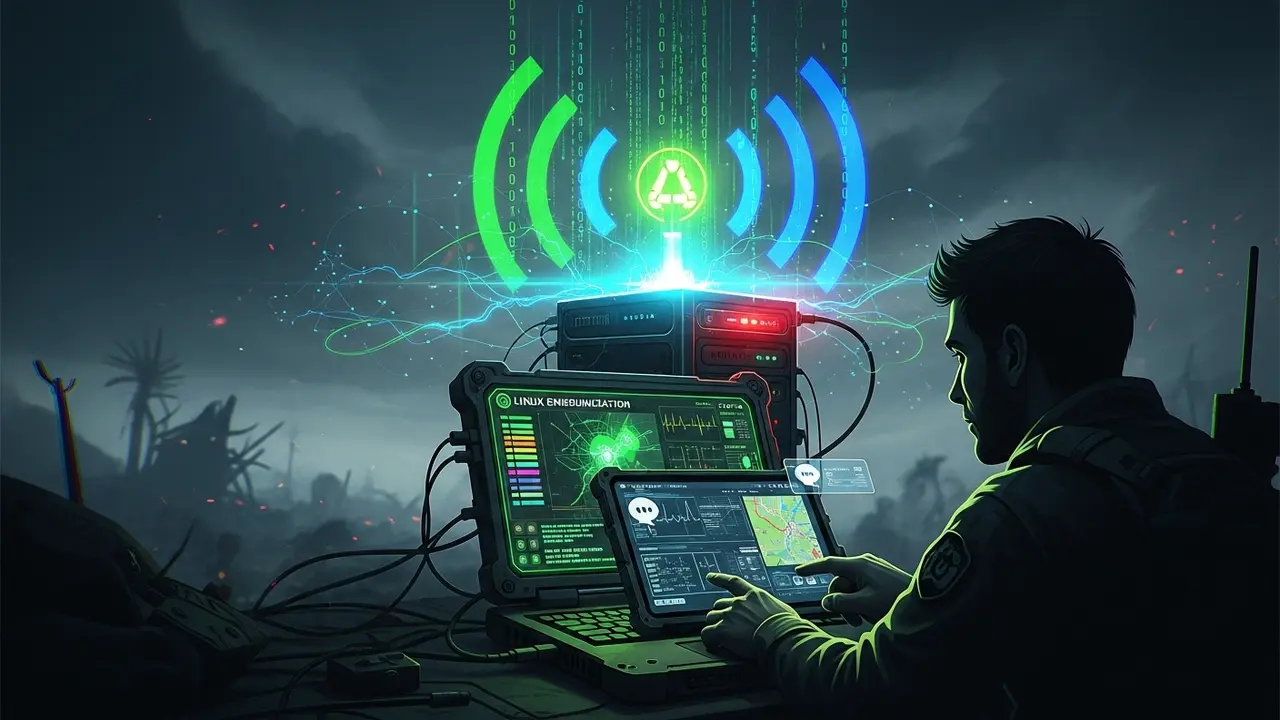
I now keep four matchbox computers ready to turn on at a twist of a key.
They run Linux.
They do not need Verizon or Comcast.
Step 1: the dirt-cheap starter kit
- Raspberry Pi 4B – $70 on eBay, fanless, uses less power than an LED bulb.
- 32 GB micro-SD – €6 at the grocery store.
- Long-Range “LoRa” hat – takes 5 V over the GPIO pins, plugs straight into the Pi.
- Whip antenna – I salvaged one from a dead baby-monitor camera.
That single kit talks to any identical kit in a 3-mile bubble.
If you add a clear line of sight, 10 miles is easy.
Step 2: turn on the invisible chain
1. Download tiny-mesh.img and flash it to the SD.
2. Boot the Pi.
3. Wait for the green LED to blink three times.
4. That’s it—node online.
Repeat for every friend who can spare $80.
The software quietly handles meshing in the background.
Messages hop from node to node until they find the one user who has an uplink—say the corner store with working Starlink.
Plug In When You Need Voices, Not Just Texts
Texts are good, but hearing a loved one is better.
I run Asterisk, the open-source phone switch, on the Pi.
Pro tip: grab the Zoiper app on your phone when the network goes down.
Even on airplane mode + Wi-Fi, you can still dial another person on the same mesh.
All I set up:
- A single SIP account (“/emergency”)
- A priority queue, so fire or rescue calls bump to the front.
- A recorded lost-and-found script at extension “0”.
Power: Keep the Blinking Lights Alive
Batteries feel huge until you drain one bingeing Netflix.
I built a lunchbox-size solar charger that keeps my node speaking three full days:
- 20 watt folding panel—$12 at a camping surplus.
- LiFePO4 battery sold for golf-cart radios—far safer than Li-ion in the attic.
- Automated LED strip on the lid turns red at 20 % battery—no guessing games.
A napkin-calculation: one sunny May afternoon fills the pack halfway, enough for 40 hours of constant chatting or 4 days of pings every five minutes.
Real-World Drill: the Windstorm Weekend
We cut our own power for 48 hours on purpose.
Same deal: neighbors vs. the “official” drill.
Results
- Cell phones depleted by hour six.
- Four kids in my backyard used the mesh to keep a Minecraft clone running over LoRa (!).
- Emergency-services test? Fire captain dialed Asterisk extension “911test,” got patched through the township repeater 7 miles away. He didn’t believe the ticket price.
Security: Close the Door to Snoopers
Disaster zones spawn trolls; the last thing you need is prank “evacuation” broadcasts.
I wrap the whole mesh inside WireGuard, a tiny VPN that fits on a 64 MB overlay.
Each Pi gets a pre-shared key scratched onto a luggage tag.
Plug cable—done.
Zero hand-holding once the kit boots.
Packing Up: Armor the Pi
Hardware likes to get wet, hot, or stepped on.
Cheap fixes:
- Hobby-grade Nema box from Amazon ($14) keeps rain and curious raccoons out.
- Add a 40 mm computer fan; it draws 0.2 W and buys you 10 °C of heat buffer.
- Stick on a $3 fridge magnet—now it lives underneath the attic vent or on the shed roof.
The Five-Minute Monthly Ritual
I boot the node every first Sunday while coffee brews.
If it beeps the “good-health” tone, I shut it down and stash it back on the shelf.
Maintenance? Takes longer to refill the cat bowl.
Start Now. One Node Beats Zero.
No seminars, no $5,000 radios, and definitely no jargon like “quantum-resistant encryption” to scare Grandma.
Grab a Pi tonight; run the SD image; put thirty bucks into a battery.
By the end of the weekend you’ll be the nerd who still has a voice when the next big wind shows up.
Because the hour the lights flicker, you won’t wish you knew more Linux.
You’ll wish you knew where that plastic lunchbox was hiding.